


Sustainable Acoustics team at Newhouse Farm Open Day
Communicating our work: How acoustics can help regenerative farming and deliver more sustainable food systems if we listen to the land.
A team from Sustainable Acoustics Ltd exhibited at the Newhouse Farm Open Day on Sunday 7 June 2026. We brought along a range of fascinating acoustic kit to show the visiting public how we can listen to the land and as a result learn about our natural environment and support regenerative farming.
Newhouse Farm is a LEAF farm (Linking Environment and Farming) and is part of the Winchester Downs Farm cluster. At Newhouse Farm they are actively working towards a more sustainable farming model, experimenting with regenerative practices to enhance the environment: including precision techniques to drill, fertilise and protect crops and minimising tillage to enhance the structure and health of their soils.
Humanity is just beginning to understand how important soil health is. The top six inches of soil is the critical layer, like a healthy skin on the earth. Given the role of soil in supporting and sustaining our lives, it is unsurprising that studies have discovered there are profound connections between soil health and human physical and mental wellbeing.
Dr Simon Jeffrey, a reader in soil ecology at the Harper Adams University, in his blog article dated 6 July 2020, explains, “soil is literally vital to our survival. Globally, more than 99% of the calories we eat comes from food that has been grown in soil, either directly (crops) or indirectly (livestock). As such, soil degradation – the reduction or loss of soil functions – is one of the greatest threats to global civilisation.”
There is still much to learn about this vital and complex soil system which supports most of our food-growing system. LEAF farms, like Newhouse Farm, are supporting scientific research to help us gain more understanding. Since September 2025, Sustainable Acoustics Ltd has been carrying out a pilot study at the farm looking into whether we can use acoustics to assess soil health, as well as using acoustics to quantify biodiversity through monitoring wildlife such as birds, bats and crickets.
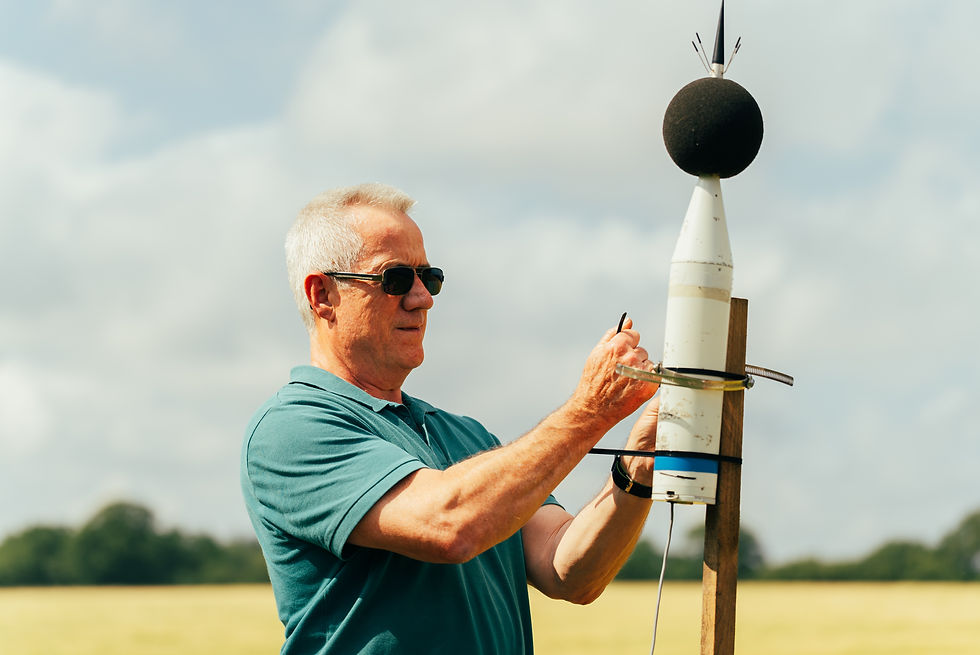
We began our ‘Listening to the land’ project to gather wildlife data using the Audio moth Eco-Acoustic monitors and a more traditional precision sound level meter: but also a new innovation in the field of Passive Acoustic Monitoring (PAM) equipment – a Soil Acoustics meter, which uses a probe to gather data to determine soil health. The results of the pilot study are being shared in a scientific paper being submitted to the Annual Institute of Acoustics (IOA) Conference in October, by author Kristina Baker together with Andy Officer and Peter Rogers. We believe acoustic techniques are going to become an extremely helpful non-invasive way to nationally assess Biodiversity Net Gain (BNG) and soil health. We are truly excited by the significant strides over recent years in the development eco-acoustic monitoring devices and by AI powered software to aid in wildlife identification.
In the meantime, at the Open Day we shared some of our results comparing the number of birds and bats identified above the crops over a control area of field, verses the agroforestry experimental field. The measurable differences can be put down to objective evidence of the effect of this intervention.

To engage youngsters and adults alike, we also ran a bird-sounds identification quiz, using sounds from bird species identified as avian visitors to the Newhouse Farm agroforestry experimental plantings strips. This went down extremely well with the public and we had over 16 families and individuals completing the quiz. The best score was 15 out of 18.
Youngsters also enjoyed the ‘acoustic egg’ (Anechoic Chamber) and jumping up and down on the ground and triggering the low frequency probe in the ground attached to a speaker – simulating ‘worm-grunting’.

We spoke to over 100 people throughout the day about eco-acoustics and the role acoustics can play in restoring wildlife and delivering more regenerative food systems. Our anechoic egg created quite a bit of curiosity, showing how sound engages all ages!
By Diana Rogers
Sources
Newhouse Farm Open Day Event


